Vecul — Car Sharing
Designing trust and operational structure for Nigeria’s fragmented vehicle rental market.
PROJECT DETAILS
Role
Lead Product Designer
Responsibilities
Product Strategy • UX Research • Information Architecture • Marketplace Flows • Trust & Verification Systems • Cross-functional Collaboration
Team
1 Product Designer • 2 Product Managers • 2 Frontend Developers • 3 Backend Developers • 1 Business Analyst
Scope
Web & Mobile
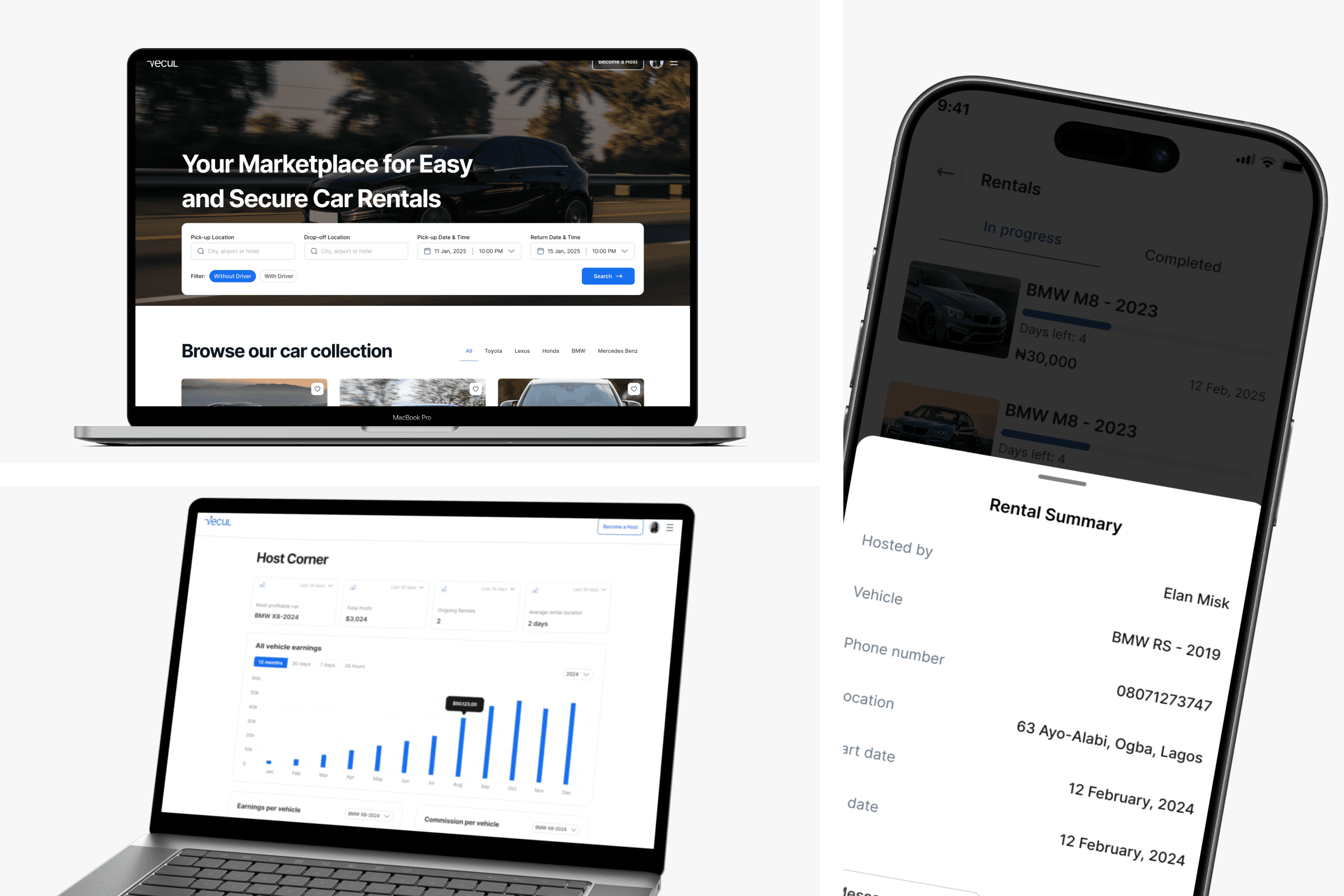
Homepage, Host reports and mobile view of booking confirmation
Overview
Vecul is a trust-driven vehicle rental marketplace designed to simplify how renters, vehicle owners, and rental businesses discover, verify, and coordinate vehicle rentals across Nigeria’s largely informal rental ecosystem.
Built as an MVP, the platform aimed to reduce the friction of manual booking processes while introducing greater transparency, accountability, and operational structure into the rental experience.
Renting a vehicle in Nigeria often relied on informal referrals, manual coordination, and inconsistent pricing. Renters had limited visibility into vehicle quality, reliability, or pricing, while vehicle owners struggled with trust, verification, and operational inefficiencies.
The Challenge
The challenge wasn’t simply building a booking platform.
The bigger challenge was designing enough trust and operational structure for strangers to confidently rent vehicles from one another in a market largely driven by informal processes.
This meant solving for:
inconsistent pricing and referral markups
lack of standardized reviews or accountability
theft and vehicle damage concerns
booking coordination and availability conflicts
insurance ambiguity
operational inefficiencies for rental businesses
low trust between renters and hosts
unreliable payment infrastructure
fragmented vehicle discovery
Beyond the user experience itself, the platform also needed to balance the operational realities of onboarding businesses, verifying vehicles, handling payouts, and preventing fraud at scale.
My Role
As the lead product designer, I worked across both product and operational decisions throughout the MVP phase.
My responsibilities included:
conducting user research and competitive analysis
defining marketplace flows and information architecture
designing renter, host, and business onboarding experiences
shaping trust and verification systems
designing dashboards and operational workflows
collaborating with developers on booking and extension logic
contributing to go-to-market and scalability discussions
participating in stakeholder, investor, and partnership conversations
Beyond the user experience itself, the platform also needed to balance the operational realities of onboarding businesses, verifying vehicles, handling payouts, and preventing fraud at scale.
Research & Key Insights
To better understand the realities of vehicle rentals in Nigeria, I conducted user interviews and analyzed existing rental behaviors across both individuals and rental businesses.
What initially appeared to be a simple booking problem revealed a much deeper issue around trust, coordination, pricing transparency, and operational reliability.
Several patterns consistently emerged during research.
01
Rentals were heavily dependent on informal networks, with most users relying on referrals, social media, or personal contacts to find vehicles.
02
Referral-based rentals often introduced hidden price markups. Intermediaries frequently added commissions while passing requests resulting in poor pricing transparency and no reliable way to compare options.
03
Existing systems lacked verification, insurance clarity, damage reporting, and structured reviews, leaving owners to carry most of the risk and making trust a core product requirement.
04
Users preferred temporary vehicle access they could control on their own schedule instead of repeated ride bookings. They also wanted clearer pricing, better comparisons, upfront feature visibility, and fallback options
05
Businesses saw strong value in centralization. Many already managed rentals manually through WhatsApp or calls, making scaling difficult.
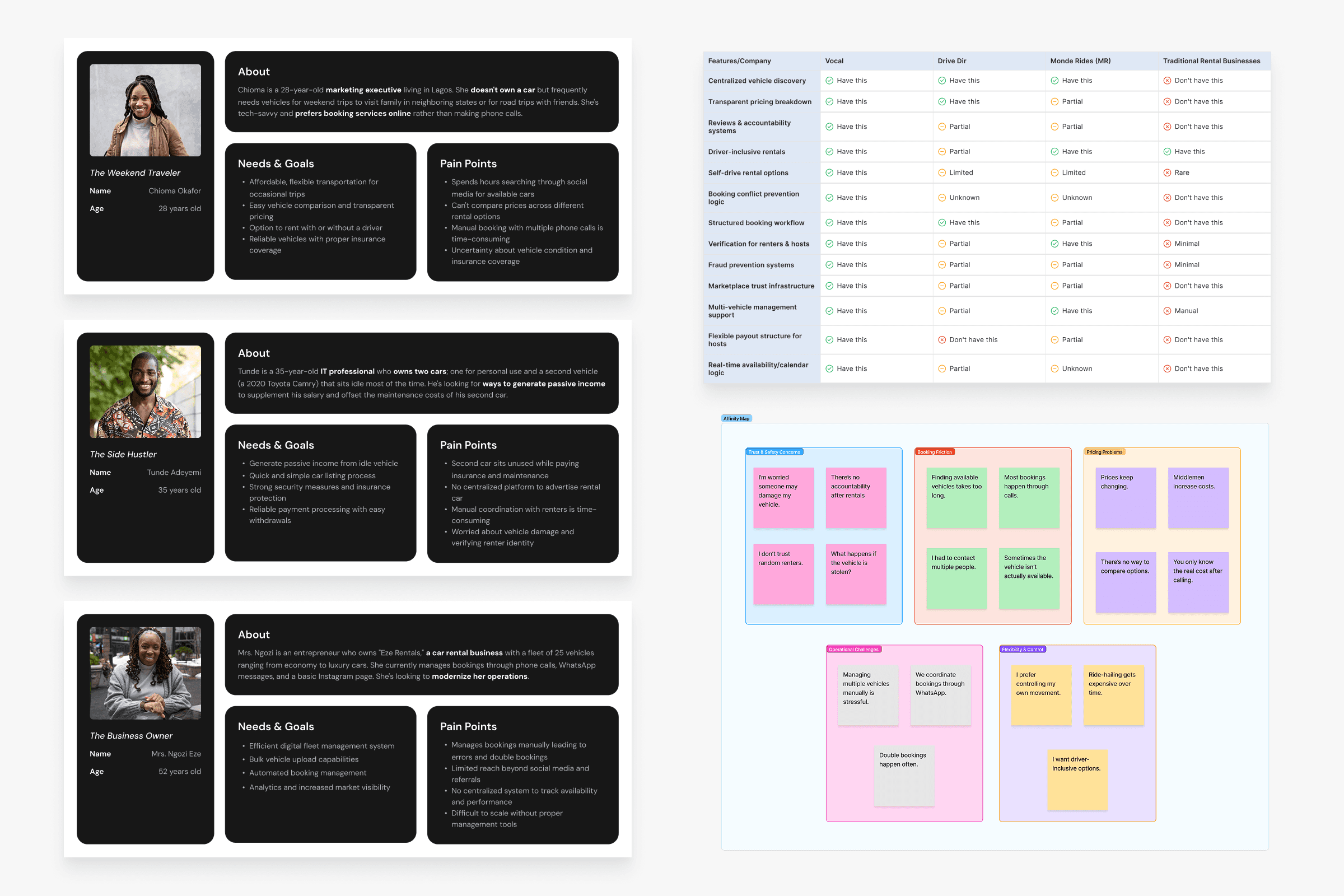
User Personas, competitive analysis and affinity map. Other research carried out are not shown here
Designing Trust Into the Marketplace
One of the biggest product challenges was designing enough trust for strangers to confidently rent vehicles from one another.
Rather than treating trust as a single feature, we approached it as a system that needed to exist across onboarding, booking, payouts, verification, and vehicle management.
Layered Verification For Renters and Hosts
To reduce fraud and improve accountability, the platform introduced multiple verification layers for both renters and vehicle owners.
This included:
government-issued ID verification
driver’s license verification
national identification verification
vehicle ownership checks
The goal wasn’t only verification. It was creating visible signals that increased confidence across both sides of the marketplace.
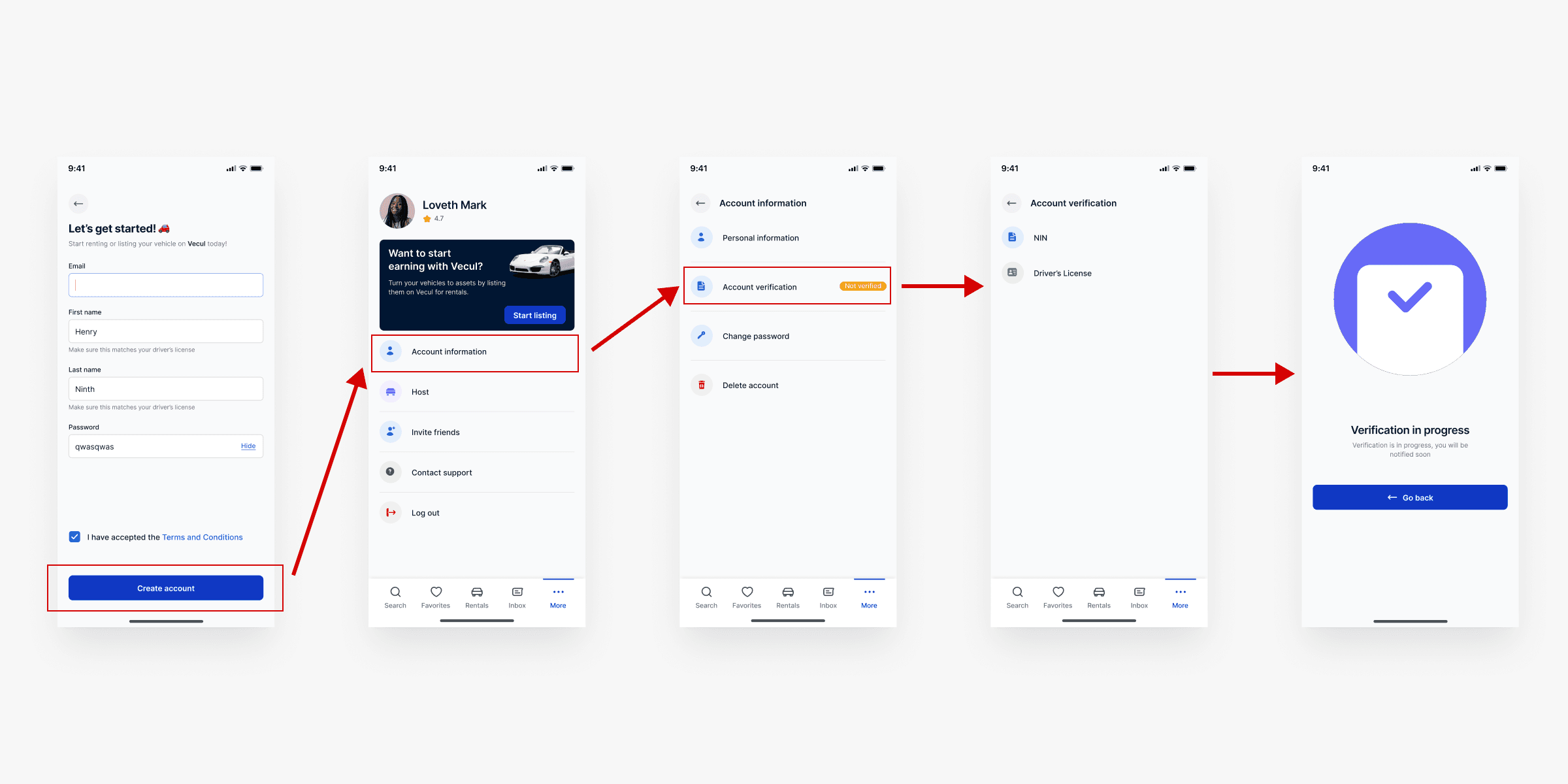
Onboarding to account verification flow
Designing Payout Logic Around Trust and Fraud Prevention
One of the more operational product decisions involved how payouts would work between renters, hosts, and the platform.
Instead of immediately releasing full payments to hosts, payouts were structured in stages:
an initial percentage released during the active rental
the remaining balance released after successful completion of the booking
This approach helped reduce fraud risk, support dispute resolution, and create additional accountability across both sides of the transaction.
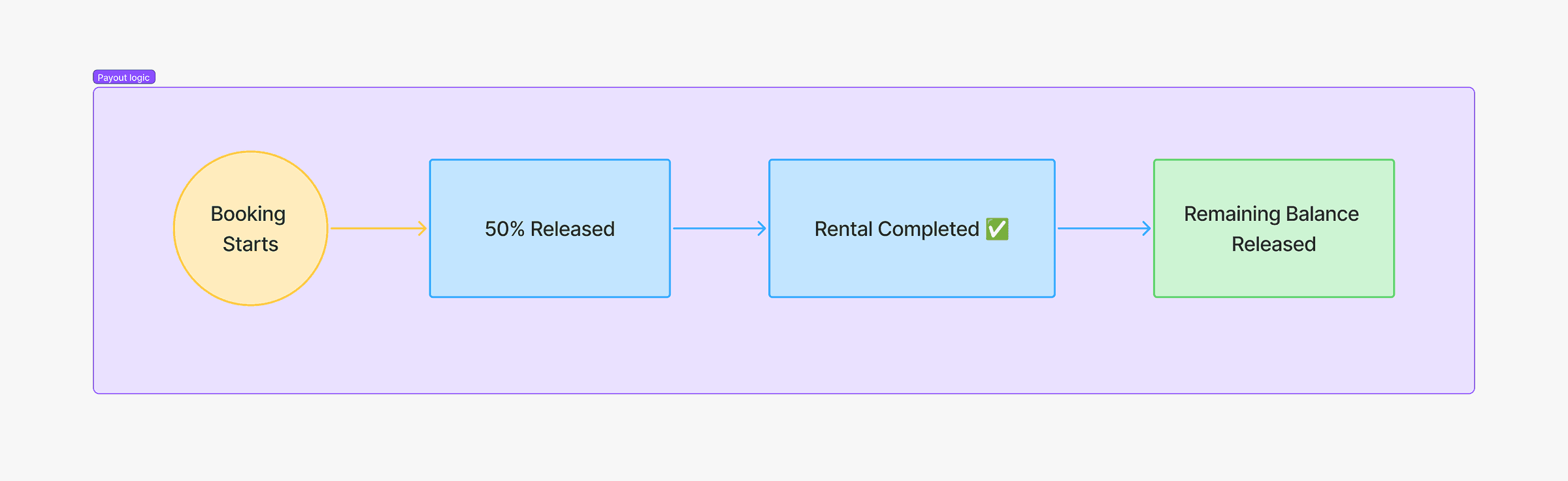
Payment logic flow for hosts
Transparent Pricing and Insurance Visibility
Insurance and payment transparency became critical parts of the experience.
Users needed clarity around:
service charges
insurance coverage
booking costs
payment responsibilities
Rather than hiding additional fees, the experience intentionally surfaced pricing breakdowns and insurance-related information throughout the booking flow to reduce uncertainty and build confidence before payment.
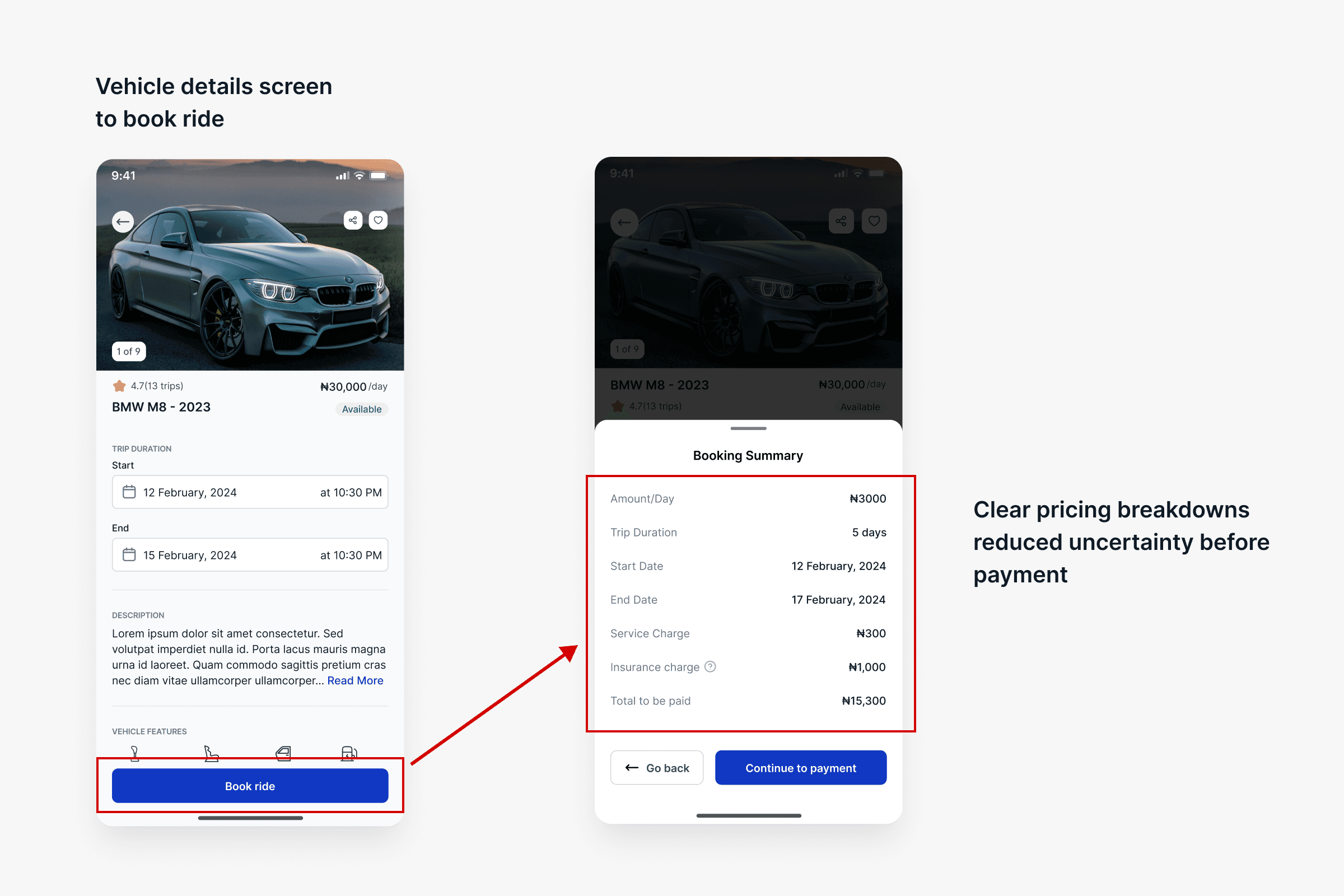
Transparent booking and pricing breakdown
Operational & Marketplace Complexity
Beyond the marketplace experience itself, several operational challenges emerged while designing the platform.
These problems extended beyond interface design and required thinking through scalability, coordination, and real-world platform behavior.
Balancing Speed With Booking Reliability
One major friction point involved urgent bookings.
The platform aimed to make same-day rentals possible, but approval-based booking flows created delays when hosts were unavailable to respond quickly.
This introduced tension between:
fast booking experiences for renters
approval control for hosts
Balancing both sides of the marketplace became an ongoing product challenge.
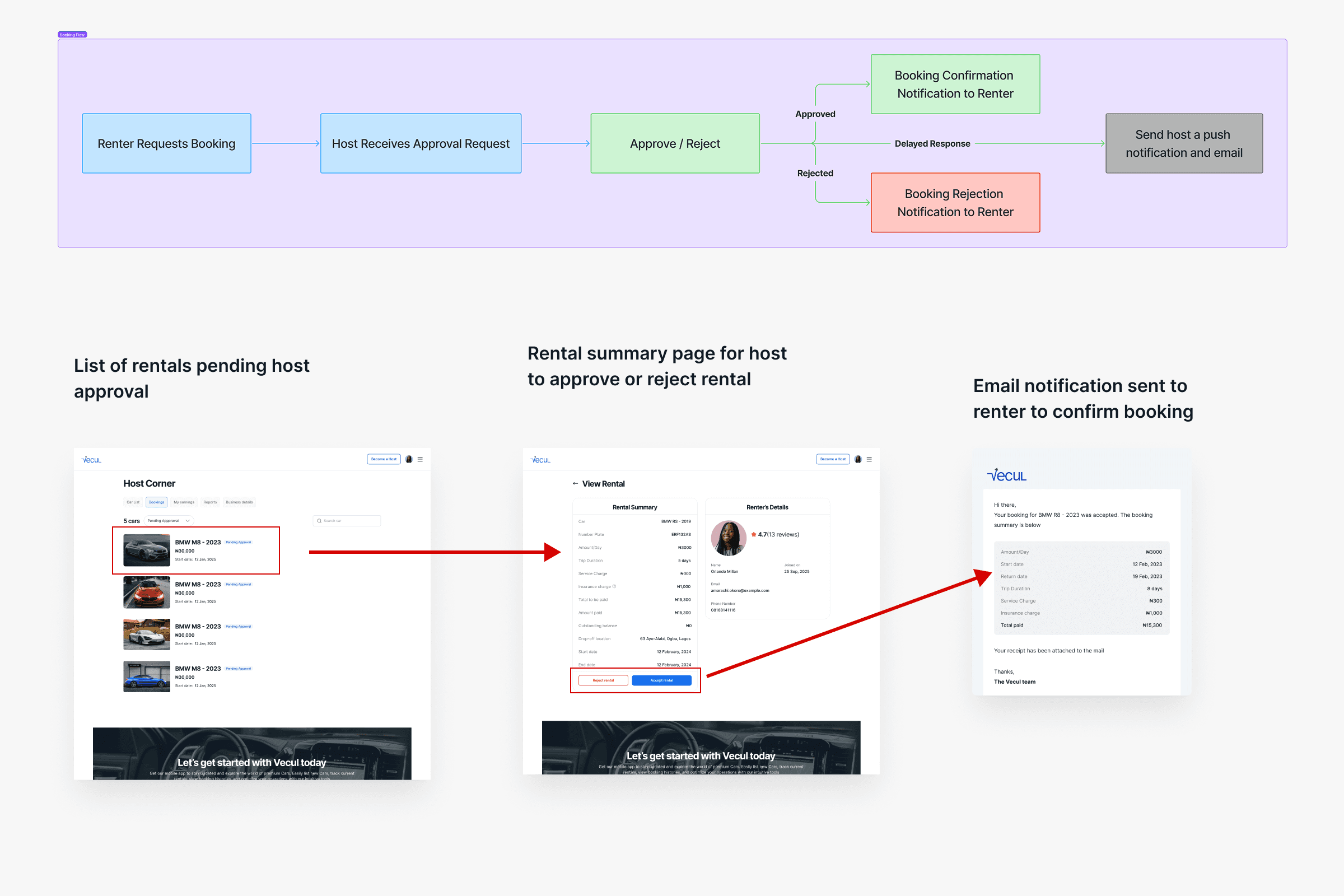
Booking confirmation flow
Handling Rental Extensions and Booking Conflicts
Rental extensions introduced additional operational complexity.
If a renter wanted to extend an active booking while another renter had already reserved the same vehicle, the platform needed a clear way to manage conflicts without disrupting future reservations.
This led to several discussions around:
calendar logic
extension windows
booking priority
host approval behavior
and highlighted how operational edge cases significantly influenced product decisions.
Product Evolution
As the product evolved, several assumptions changed based on research findings, operational constraints, and conversations with potential users and rental businesses.
Rather than treating the marketplace as a static peer-to-peer platform, the product gradually evolved into a more operationally structured system designed to support both individuals and businesses.
Introducing Driver-Inclusive Rentals
Another major product shift came from understanding local mobility realities.
Some users either:
did not have valid local driver’s licenses
were visiting from abroad
preferred not to drive themselves
Traditional rental systems offered limited flexibility around this behavior.
To better adapt to local needs, the platform introduced driver-inclusive rental options, allowing renters to choose between self-drive and chauffeur-supported experiences during booking.
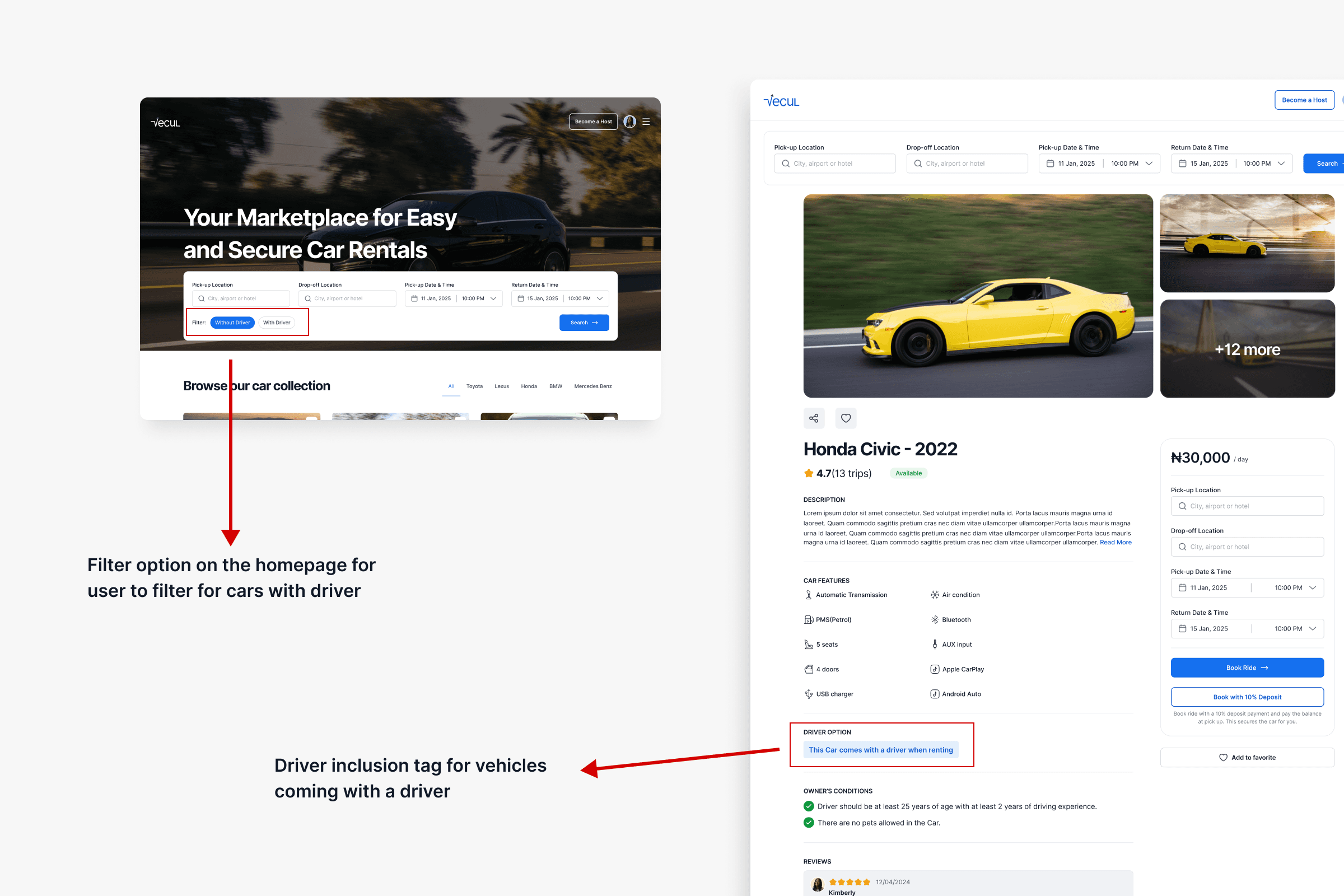
Screens showing driver options included
Expanding From Mobile-Only to Cross-Platform Access
The original MVP direction focused primarily on mobile experiences.
As business onboarding became a larger operational priority, it became clear that rental businesses managing multiple vehicles required a more scalable and operationally efficient interface.
This led to expanding the experience across both mobile and web platforms.
Key Design Decisions
Several product and UX decisions were intentionally shaped around reducing friction, improving transparency, and building trust across the marketplace.
Progressive Onboarding Reduced Friction
Vehicle onboarding involved multiple operational requirements.
Instead of overwhelming hosts with long forms, onboarding was broken into smaller, guided steps with visible progress indicators.
This reduced cognitive load while helping users understand what information was required at each stage.
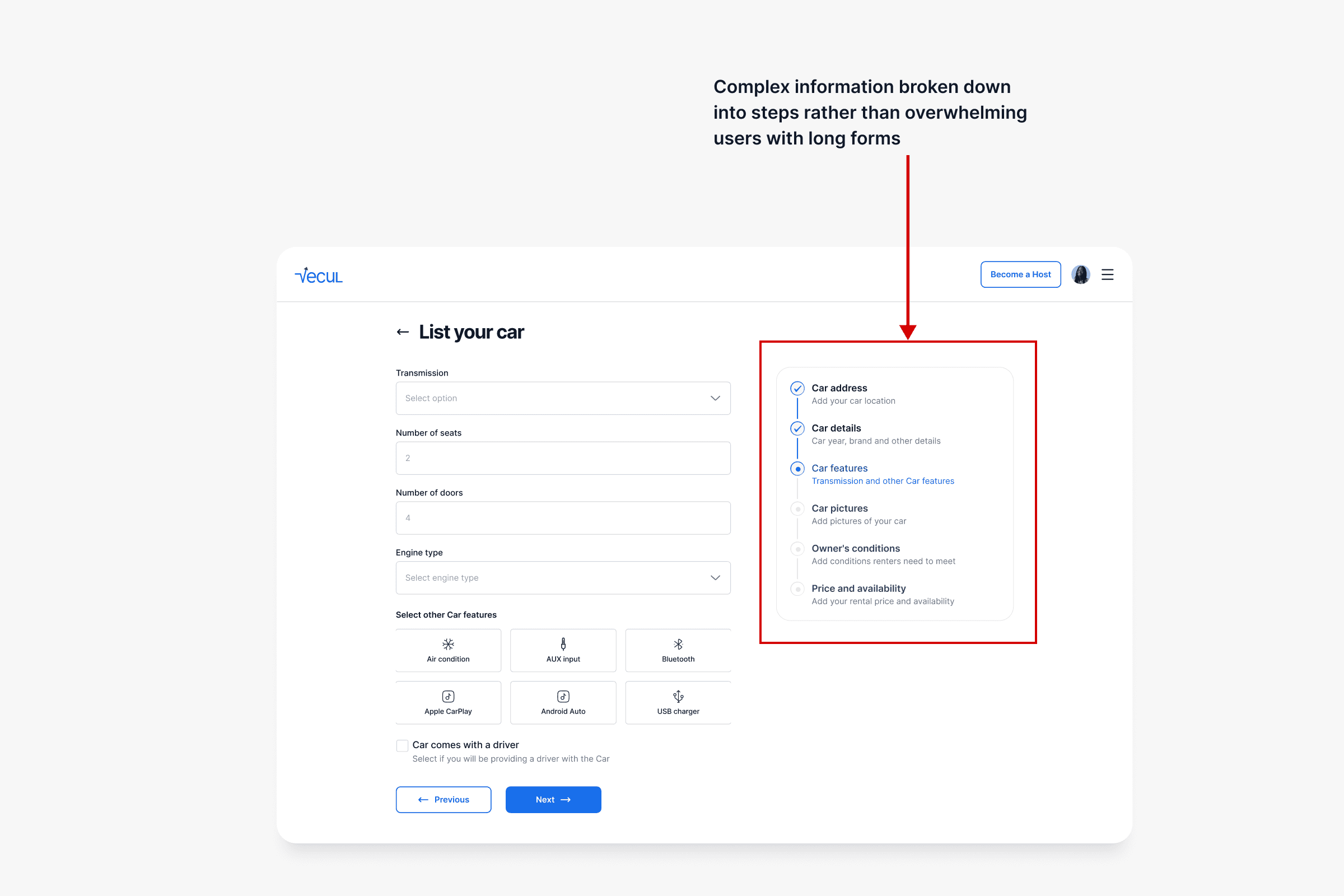
Progressing car listing step reducing cognitive load
Card-Based Browsing Improved Comparison
One of the biggest user frustrations was the inability to compare rental options efficiently.
The marketplace experience was designed around scannable vehicle cards that surfaced pricing, ratings, transmission type, seating capacity, and key features.
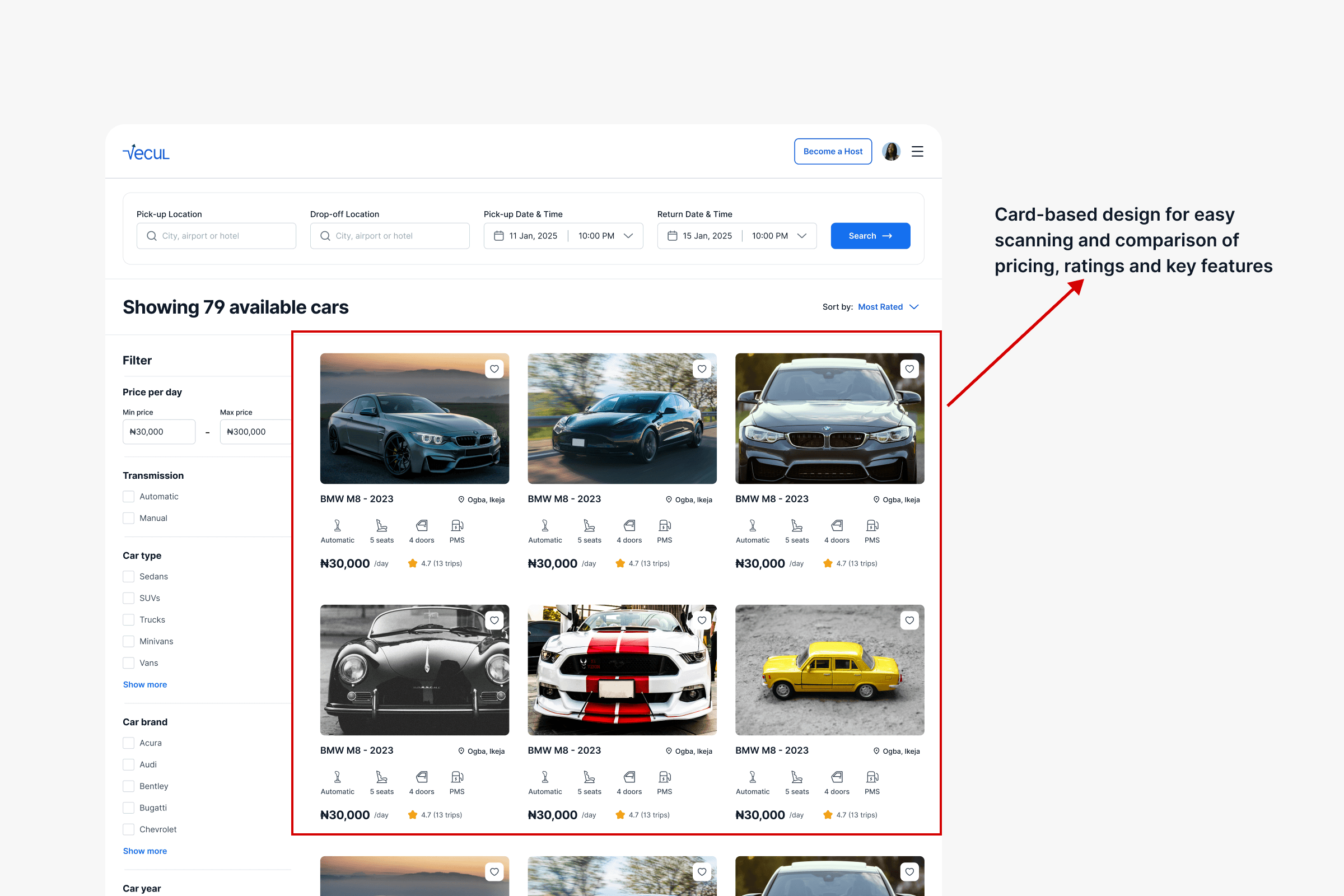
Card listing for better price and feature comparison
Transparency Was Prioritized Throughout Booking
Trust concerns influenced nearly every stage of the booking experience.
To reduce uncertainty before payment, the platform surfaced:
pricing breakdowns
insurance information
host details
vehicle conditions
reviews
booking expectations
What Remained Unresolved
Because Vecul was still in its MVP stage, several operational and marketplace challenges remained unresolved.
01
Insurance complexity remained a major operational challenge
Questions around liability, vehicle damage, third-party coverage, renter responsibility, and fraud prevention required operational and partnership decisions that extended beyond product design alone.
02
Scaling verification operations raised sustainability concerns
Verifying vehicles, ownership, roadworthiness, and business legitimacy required manual processes and external coordination that would become increasingly difficult to maintain as supply scaled.
03
Business onboarding introduced operational complexity
Bulk uploads, large inventory management, and onboarding coordination required additional operational tooling that had not yet been fully solved within the MVP.
Outcomes & Early Impact
Although Vecul remained in its MVP phase, the project helped validate several key assumptions around marketplace demand, operational friction, and trust-driven rental experiences within the Nigerian market.
Key early improvements included:
Reducing rental discovery and booking from lengthy manual coordination to a streamlined digital process
Enabling hosts to list vehicles within minutes through structured onboarding flows
Validating demand for both individual and business-based rental participation
Establishing foundational trust systems around verification, payouts, and transparency
Key Learnings
01
Trust is not a feature. It’s a system.
Trust in marketplaces must exist across every layer of the experience, from onboarding and verification to payouts, reviews, and operational policies.
02
Local behavior should shape product direction
Many of the platform’s strongest decisions came from adapting to Nigerian user behavior rather than replicating international marketplace models directly.
03
Marketplace design extends beyond interfaces
Designing the platform required thinking beyond screens and flows into operations, fraud prevention, business onboarding, support systems, and scalability.
Reflection
Vecul started as an attempt to simplify vehicle rentals, but the project quickly evolved into something larger: designing operational trust within a fragmented ecosystem.
Working on the product pushed me beyond interface design into areas like marketplace governance, verification systems, operational workflows, and business strategy.
More importantly, it reinforced the importance of designing products around real behavioral and infrastructural realities rather than idealized user journeys.